
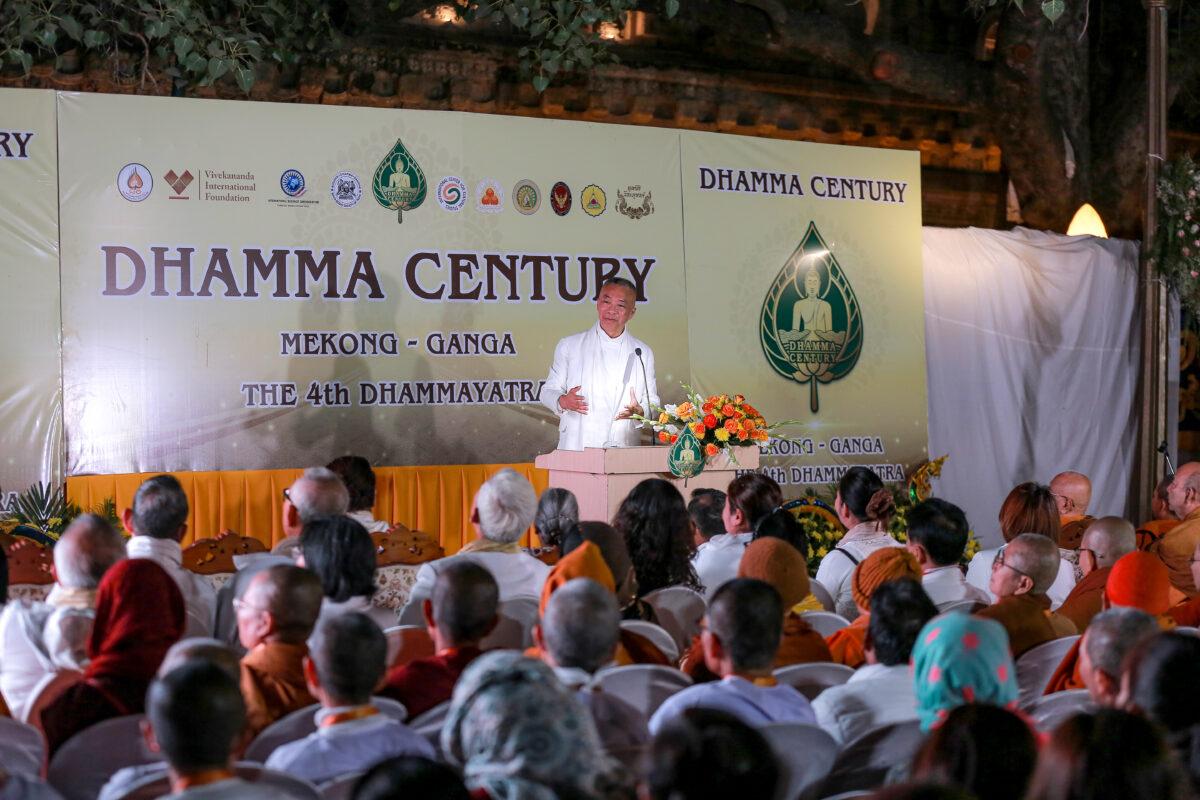
The 4th Dhammayatra: Declaration on Dhamma Century : Buddhist Dhamma Brings Peace and Happiness “Dhamma Strategy” The Heart of Declaration on Dhamma Century

The essence of " Declaration on Dhamma Century" lies in the application of the "Dhamma Teachings" of Buddhism, which emphasizes "practice" leading to "liberation" and peaceful coexistence. This concept aims to connect all religions in the world. Declaration on Dhamma Century was made on December 5, 2024, at the Maha Bodh Gaya Stupa, under the sacred Bodhi Tree — the site where the Lord Buddha attained Enlightenment (Anuttara-Samyak-Sambodhi).
The Declaration on Dhamma Century by Dr. Supachai Verapuchong, Secretary-General of the Bodhgaya Vijjalaya 980 Institute, aligns with the vision of Indian Prime Minister Narendra Modi, who declared that the "Century of Asia" can be realized when the people of Asia are united by the teachings of Lord Buddha. This vision encompasses all religions, philosophies, and cultures worldwide.

The concept of the "Dharma Century" also refers to "Dhamma Vijaya" or "Victory through Dhamma," inspired by the legacy of Emperor Ashoka the Great. After witnessing the devastation of war, Ashoka renounced conquest by force, embracing "Dhamma" as a guiding principle for peace. His transformation symbolized the idea that true victory is "victory over oneself," fostering "harmony through Dhamma.

Similarly, King Bhumibol Adulyadej (Rama IX) of Thailand followed this approach, as reflected in his first royal pronouncement, "We shall reign with righteousness," embodying the ideals of Dhamma rule.
Another Purpose of Declaration on Dhamma Century was a response to the ongoing global conflicts, including armed disputes, political crises, economic inequality, and social divisions. To realize the vision of the " Dharma Century,"
the Bodhgaya Vijjalaya 980 Institute, introduced the concept of "Dhama Strategy" — a strategy based on three main pillars:
1. Meditation Practice: Cultivating mindfulness and self-awareness as a foundation for wisdom.
2. Development of Wisdom: Reflecting on and understanding the Dhamma teachings to attain insight.
3. Following the Noble Eightfold Path: Embracing morality (Sila), concentration (Samadhi), and wisdom (Panna) as a means to enlightenment. The ultimate goal is to achieve "Right View" (Samma Ditthi), which involves understanding suffering, its causes, and the path to its cessation.
Apart from India Think Tanks, the historic declaration was supported by a coalition of senior monks, lay leaders, and global Buddhist institutions of the BodhgayaVijjalaya 980 Institute. Among the key figures were Phra Brahma Wajirayan, Phra Methiworayan, Abhai Chantanchulaka, Thipawan Verapuchong, Surasak Triratanakul, Kasem Moonjan, Suraphon Maneepong, Vorasak Prayoon Sook, Dr. Atcharawadee Manchat, Sarit Witoon (former Governor of Ubon Ratchathani Province), and the President of the Maha Bodhi Society of Sri Lanka, Bhikkhu Upatissa Thero.
***Time Capsule: To Be Opened in 234 Years***

One of the highlights of the Declaration on Dhamma Century was the burial of a "Time Capsule" containing the declaration message and a letter from the Secretary-General of the BodhgayaVijjalaya 980 Institute to the People of the Future, 234 Years from Now. The core message of the letter highlights the origins of the BodhgayaVijjalaya 980 Institute, established to protect and promote Buddhism through the policy of “Buddhism Revolutionizing the World” and “Buddhism Revolutionizing Suvarnabhumi”. This mission was inspired by the final will of Phra Maha Phong Samalerk, the President of the Lao Central Buddhist Organization. His directive was to organize the "Five Countries Mekong Dhammayatra" initiative, which has taken place twice so far.
The 3rd Dhammayatra involved the enshrinement of the Buddha's relics and the relics of the Buddha's chief disciples from India for temporary veneration in Thailand. This event took place from February 22 to March 19, 2024. Building on its success, the 4th Dhammayatra took place from December 2 to 10, 2024, under the theme "Mekong Ganga Dhammayatra". This journey reflected the evolution of the concept of the "Century of Asia" into the " Dhamma Century ". This capsule will be opened 234 years later, in 2801 CE. The number 234 has significant meaning. It refers to 234 BCE, when Emperor Ashoka sent nine missions of Buddhist emissaries to spread the Dhamma worldwide. The sum of 2 + 3 + 4 = 9, symbolizing King Bhumibol Adulyadej (Rama IX) of Thailand, a champion of religious support in Thailand.
The Time Capsule will be buried in three sacred locations in India and Suvannabhumi: 1. Bodh Gaya, India — the site of Lord Buddha’s enlightenment. 2. Gujarat, India — the birthplace of Prime Minister Narendra Modi. 3. Wat Mahathat Yuwaratrangsarit, Thailand — a major royal Buddhist monastery.
***Patna: The Starting Point of the 4th Dhammayatra Following in the Footsteps of Emperor Ashoka***
The city of "Patna", located in the state of Bihar, Republic of India, is one of the oldest cities in the world. Historically known as "Pataliputra", it once served as the capital of the ancient Maurya Empire under the rule of Emperor Ashoka the Great. It was in this city that the Third Buddhist Council was held. Following the council, Emperor Ashoka dispatched Buddhist missionary delegations to propagate Buddhism across nine different regions. The 8th route of this mission saw Venerable Sona Thera and Venerable Uttara Thera sent to Suvarnabhumi (believed to be parts of present-day Southeast Asia).
The 4th Dhammayatra received a warm welcome from the highest-ranking official of Bihar State, Governor Rajendra Arlekar, who opened the state guesthouse in Patna to host the 4th Mekong Ganga Dhammayatra to Buddhabhumi: Declaration on Dhamma Century delegation led by Dr. Supachai Veerabhujong, Secretary-General of the BodhgayaVijjalaya 980 Institute 980, with participation from network partner organizations, including the International Buddhist Confederation (IBC), led by Most Venerable Jangchup Choeden Secretary-General.

The Governor of Bihar praised the success of the 3rd Dhammayatra, which linked the Ganges River with the Mekong River. As part of this collaboration, he personally traveled to Thailand to participate in the enshrinement of the Buddha's relics and the relics of the two chief disciples (Sariputta and Moggallana) from February 22 to March 19, 2024 (2567). This effort demonstrated the shared reverence of the Thai and Indian people for the Buddha and how the Buddha’s teachings act as a unifying link between the two nations.
Similarly, Jangchup Choeden, Secretary-General of the International Buddhist Confederation, traveled to Wat Mahathat Wachiramongkol in Krabi Province, Thailand, the final site for the enshrinement of the Buddha's relics and the relics of the Arahants. The event showcased the devotion of thousands of people, including both Buddhists and Muslims, who gathered to pay their respects and express their faith.
***Nalanda University: The Oldest University in the World***
Another significant city in the state of Bihar that the Dhammayatra delegation visited is Nalanda, home to Nalanda University, recognized as the oldest university in the world. The visit aimed to strengthen relations and foster collaboration under the principles of Buddhism. The administration of Nalanda University has been actively working with several universities in Thailand and closely cooperating with the International Buddhist Confederation (IBC). This collaboration is part of a broader effort to expand Buddhist networks globally, aligning with the vision of Indian Prime Minister Narendra Modi, who, in 2015, declared the concept of the “Asian Century” at the United Nations, using Buddhism as a bridge to connect the world.

During the visit, the Dhammayatra delegation had the opportunity to explore both the modern-day Nalanda University and the ancient Nalanda University, a historical Buddhist site established during the reign of Emperor Ashoka the Great. The ancient university was originally built as a monastic educational institution for Buddhist monks. One of the most prominent figures associated with Nalanda was Xuanzang (Tang Sanzang), a Chinese monk who played a vital role in transmitting Buddhist teachings and philosophy back to China, thereby serving as a bridge between the two great civilizations of India and China. The ancient Nalanda University also holds profound historical significance as it is home to the birthplace of Venerable Sariputta, one of the two chief disciples (right-hand disciple) of the Lord Buddha. The site still preserves the remnants of an ancient stupa, which serves as a symbol of remembrance and homage to the Buddha’s era. This legacy continues to inspire reverence and reflection among Buddhists and scholars worldwide.
***Indian Network Partners: Connecting Leading Organizations for the 4th Dhammayatra***
Leaders of India’s "Think Tank" network, such as the International Buddhist Confederation (IBC), India Council for Cultural Relations (ICCR), Vivekananda International Foundation (VIF), Indira Gandhi National Centre for the Arts (IGNCA), USA and International Tripitaka Chanting Council (ITCC), and the Maha Bodhi Society of Sri Lanka, played a vital role in facilitating key engagements for the 4th Dhammayatra. They coordinated meetings with prominent figures and organized academic forums to bridge knowledge between India’s think tanks and the BodhgayaVijjalaya 980 Institute, with the aim of strengthening relationships and fostering future collaborations.
As one of India’s leading think tanks, the International Buddhist Confederation (IBC) hosted the press conference for the 4th Dhammauayra at the Thai Temple in Bodh Gaya. Dr. Supachai Verapuchong, Secretary-General of the BodhgayaVijjalaya 980 Institute, reflected on the success of the 1st and 2nd Dhammayatra in 2017 and 2019. These earlier yatras were supported by leaders from five countries — Cambodia, Laos, Myanmar, Vietnam, and Thailand. One of the most significant moments was the closing ceremony of the 2nd Dhammayatra at the Angkor Wat temple in Cambodia, the world's largest religious monument. This event was made possible through the royal permission of the Cambodian King, with support from the Cambodian government.

India’s think tanks have shown great interest in deepening ties with the BodhgayaVijjalaya 980 Institute,. As part of this, two academic forums were held to welcome the 4th Dhammayatra delegation. During one of these forums, Surapol Maneepong, former Thai Ambassador to the Ministry of Foreign Affairs and a member of the Dhammayatra delegation, shared his insights. He observed that one of India's persistent challenges is the gap between the rich and the poor. He also recounted his early days as an ambassador, when ASEAN-India cooperation policies aimed to use “Buddhism to promote tourism”. He highlighted India's "Look East Policy" and its evolution into the broader "Asian Century" vision, which has now been linked to the concept of the " Dhamma Century".
Multiple Indian think tanks — including ICCS, IBC, VIF, ITCC, and IGNCA — have expressed a shared commitment to enhancing cooperation with Thailand in the realm of Buddhist diplomacy. They commended the idea of linking the five Mekong countries (Cambodia, Laos, Myanmar, Vietnam, and Thailand) as part of a broader effort to strengthen connections between South Asia and Southeast Asia.
The Thai Ambassador to India, Pattarat Hongthong, echoed this sentiment. She congratulated the delegation on the successful "Declaration on Dhamma Century ", noting that the principles of Buddhism reinforce strength in all dimensions — political, economic, and social. She highlighted the significance of the 1st, 2nd, and 3rd Dhammayatras as an example of “Buddhist diplomacy”, which aims to promote Buddhism to humanity on a global scale.

***Heading to New Delhi to Meet Two Prominent Ministers***
The 4th Dhammayatra Delegation had the opportunity to meet two prominent ministers from the central government of India.
1. Meeting with H.E. Shri Gajendra Singh Shekhawat, Minister of Culture The first meeting was with H.E. Shri Gajendra Singh Shekhawat, India’s Minister of Culture. He praised the success of the 3rd Dhammayatra, particularly the procession that brought the Buddha’s relics and the relics of Arahants from India for temporary enshrinement in Thailand. The initiative was considered a great success. The Minister warmly welcomed the arrival of the 4th Dhammayatra delegation from Thailand, led by the Bodhigayavijjalaya 980 Institute. He highlighted that “Dhamma” (the Buddha’s teachings) has the potential to unify people and promote peace through the principles of the teachings.

The Minister also emphasized the success of using Buddhism as a cultural bridge between South Asia and Southeast Asia, especially in fostering cooperation between the Ganges and Mekong River regions. He reiterated his belief that the 21st century is the "Asian Century" and stated that India will play a leading role in the Mekong region. He underscored India’s "Act East" policy, emphasizing its potential to strengthen ties between India and Southeast Asia. Indian Prime Minister Narendra Modi also reaffirmed this idea, emphasizing that this century belongs to the East, to Asia, and to India.
2. Meeting with H.E. Shri Kiren Rijiju, Minister of Parliamentary Affairs and Minority Affairs. The second minister the delegation met was H.E. Shri Kiren Rijiju, India’s Minister of Parliamentary Affairs and Minority Affairs. He welcomed the 4th Dhammayatra delegation, led by Dr. Supachai Verapuchong, Secretary-General of the Bodhigayavijjalaya 980 Institute. Other key delegates included Mr. Abhai Chanthanachulaka, Mr. Kasem Moonjan, Mr. Surapol Maneepong, Dr. Atcharawadee Manchart, and Mr. Sarit Witoon, the former Governor of Ubon Ratchathani. Academic representatives from the India Studies Center at Ubon Ratchathani University also attended the meeting.
Dr. Supachai explained the origins of the, which was established following the ordination project Bodhigayavijjalaya 980 Institute in honor of King Bhumibol Adulyadej (Rama IX) on his 80th birthday in 2007. The primary goal of the institute is to spread and protect Buddhism. Dr. Supachai also provided an overview of the four Dhammayatra journeys. The 4th Dhammayatra began in Patna, the birthplace of Emperor Ashoka the Great, who ruled through the principle of "Dharmavijaya" or "Conquest by Dhamma." The 4th Dhammayatra is seen as a symbolic journey following in the footsteps of Emperor Ashoka, promoting Dhamma (righteousness) as a means to bring peace and unity.
During every meeting with Indian dignitaries, Dr. Supachai reaffirmed his commitment to work for the Buddha, Emperor Ashoka, and the "religion" (Buddhism) until his final breath.
H.E. Shri Kiren Rijiju praised the Bodhigayavijjalaya 980 Institute, particularly Dr. Supachai Veerabhuchong, for his dedication not only to Buddhism but also to strengthening Thailand-India relations. The Minister pledged continued support for the activities of the Bodhigayavijjalaya 980 Institute.

Earlier, Minister Rijiju had met Dr. Supachai in Sanchi at the enshrinement ceremony of the relics of the Buddha’s two chief disciples, Sariputta and Moggallana. During that occasion, he gave an exclusive interview to the Thai media, in which he conveyed Prime Minister Narendra Modi’s message to the United Nations, declaring the "Asian Century" and India’s vision of using Buddhism to unite the world. According to Rijiju, "Dhamma" (Buddhist teachings) transcends borders and has universal relevance, as it can resonate with people from all walks of life. If the world adheres to the teachings of the Buddha, it will foster "love, peace, and harmony" globally.
The opportunity to meet two high-ranking ministers from India’s central government marks another step forward for the 4th Dhammayatra. Their support for the vision of a "Dhamma Century " and their commitment to fostering future cooperation is seen as a crucial milestone.
***Gujarat: Visit the Birthplace of India's Prime Minister and Another Time Capsule Burial Site***

One of the key tourist attractions in Gujarat, the birthplace of India's Prime Minister, is Vadnagar, an important ancient site reflecting the history and culture associated with both Hinduism and Buddhism. A point of interest at this site is the remnants of an ancient stupa containing Buddha's relics. Vadnagar holds further significance as it is believed that Xuanzang (Tang Sanzang), a Chinese monk and pilgrim, traveled from China to India in the 7th century to study and collect Buddhist scriptures. This highlights the historical and religious ties between India and China. Dr. Supachai also brought a time capsule containing three essential messages, one of which is a declaration on Dhamma Century and another message for people of the future. He conducted a prayer ceremony to bless the capsule, and plans are being made to select a site for its burial in Gujarat as part of a symbolic act to preserve spiritual and cultural heritage for future generations.
***“Devni Mori”: The Indian Prime Minister’s Grand Religious Project***
A major future project in Gujarat, driven by the vision of Prime Minister Narendra Modi, is the development of a grand project known as “Devni Mori”. This project aims to create a “center for religion, culture, and learning” to connect significant Buddhist pilgrimage routes, namely Bodh Gaya, Rajgir, and Sarnath. As part of the Devni Mori project, an international Buddhist learning and meditation center will be established to promote education and practice of Buddhism on a global scale. Currently, Devni Mori is a large reservoir where excavations have revealed an ancient submerged city beneath the Meeshwo River. This ancient city is believed to have strong connections with both Hinduism and Buddhism, dating back more than 2,000 years.


Additionally, Devni Mori is home to an important Buddhist stupa that was excavated and found to contain Buddha's relics encased in a stone casket. Archaeologists have speculated that Devni Mori might have served as a Buddhist religious center during the time of the Gupta dynasty (4th–6th century CE), further indicating the region's historical prominence in the spread of Buddhism.
As part of their pilgrimage, the Dhammayatra delegation visited and paid homage to sacred sites near Devni Mori, including Shamlagi Temple, where devotees worship Lord Krishna and Lord Vishnu. This temple reflects the beliefs and cultural practices of the Hindu community while also showcasing the coexistence of Buddhist and Hindu religions in the same space. Nearby, the Shamlagi Museum exhibits ancient artifacts and objects related to Hinduism and Buddhism from the Gupta era, further reinforcing the region's historical and cultural significance. All these sacred sites are part of the development plan for the “Devni Mori Grand Project”, which aims to become a center for Buddhist studies and an international meditation hub.
***Meeting with the Chief Minister of Gujarat: Strengthening People-to-People Connections and Engaging "The Young Generation"“**
An important opportunity for the 4th Dhamma Yatra delegation of the Bodhigayavijjalaya 980 institute was a meeting with the Chief Minister of Gujarat, Bhupendra Ragnikant Patel. During the meeting, the Secretary-General of the Bodhigayavijjalaya 980 institute summarized the achievements of the four Dhammayatra missions and highlighted the opportunity to meet with two Union Ministers responsible for religious and cultural affairs in India. Currently, the Bodhigayavijjalaya 980 institute is working closely with partner organizations such as IBC, ICCS, IGNCA, and VIF, while also holding discussions at both ministerial and state levels. The key focus of these discussions is to foster “people-to-people” relations, particularly among young people from Thailand and India. The first initiative under this approach involves using “influencers” from Thailand and India to build connections through one of the most popular sports — football.

At the end of the meeting, the Chief Minister of Gujarat witnessed the signing of a “Memorandum of Understanding (MoU) on the Promotion and Development of Tangible and Intangible Buddhist Heritage”. This MoU was signed between the the Bodhigayavijjalaya 980 institute and the Tourism Department of Gujarat. Tangible Buddhist heritage includes historical and archaeological sites such as stupas, ancient temples, Buddha statues, and the Tripitaka (Buddhist scriptures). Intangible Buddhist heritage refers to key principles and teachings such as the Four Noble Truths, the Noble Eightfold Path, and meditation practices. This MoU aims to support cultural exchange and the preservation of both tangible and intangible Buddhist heritage in Gujarat, Thailand, and the Greater Mekong Subregion.
***Paying Homage to the Relics of the Buddha and Sacred Ashes for Blessings***
During their journey in Gujarat, the 4th Dhammayatra delegation of the Bodhigayavijjalaya 980 institute paid homage to the “sacred ashes” of the Buddha, which are preserved in a stone casket stored in a secure vault at the Archaeology and Ancient History Museum of Maharaja Sayajirao University of Baroda (MSU). These sacred ashes of the Buddha are part of the archaeological relics unearthed from the Devni Mori excavation site. This discovery highlights the historical and cultural significance of the region, reflecting its role in preserving Buddhist heritage.


Earlier, during their stay in New Delhi, the delegation was invited by IBC (International Buddhist Confederation) to pay homage to the Buddha's relics, which had previously been enshrined temporarily in Thailand. These relics are regarded as a priceless treasure of Buddhism and world cultural heritage, underscoring the enduring significance of Buddhism, which originated in the Buddhist homeland of India.
***"Sanchi": Paying Homage to the Relics of the Arahants – The First Milestone of the 4th Dhammayatra***

Every year, on the last Sunday of November, the Great Stupa of Sanchi opens its doors to the public — including people from India, Sri Lanka, and the international community — to pay homage to the sacred relics of two of the Buddha's foremost disciples, Venerable Sariputta and Venerable Mahamoggallana. These relics, discovered inside a stone reliquary within Stupa No. 3, were brought from the Victoria and Albert Museum in London, UK, to the Great Stupa of Sanchi in 1952. Sanchi, a historic site of great importance, is home to the iconic Stupa No. 1, the principal stupa constructed during the reign of Emperor Ashoka the Great. Its hemispherical design symbolizes the "universe". A major draw for tourists from around the world is the four intricately carved "gateway arches" located in four cardinal directions. These artistic masterpieces depict scenes from the life of the Buddha, including his birth, enlightenment, and parinirvana. The gateways also feature the "Dharmachakra" (Wheel of Dhamma), symbolizing the Buddha's teachings. Venerable Upatissa Thero, President of the Mahabodhi Society of Sri Lanka, who oversees the relics of these two great disciples, invited the Secretary-General of BodhigayaVijjalaya 980 Institute to join the significant ceremony. He also expressed his support for the "Declaration on Dhamma Century" led by BodhigayaVijjalaya 980 Institute. According to Venerable Upatissa, the 21st century should be recognized as the " Dhamma Century", and all possible efforts should be made to make this declaration a reality.
Dr. Supachai Verapuchong, Secretary-General of the BodhigayaVijjalaya 980 Institute, emphasized that Buddhists today transcend national boundaries. He highlighted that the five countries of the Mekong sub-region share a common spiritual "Father" — the Buddha — and a common "Mother" — the Mekong River. Thus, all nations in the Suvarnabhumi (Golden Land) region are like siblings, bound to cooperate in every dimension. The pilgrimage to Sanchi, a monument symbolizing Emperor Ashoka's love and devotion, is seen as a symbolic act of "turning the Wheel of Dhamma" — bringing the Dhamma back from the "Land of Suvarnabhumi" to the "Land of Buddhabhumi". This journey represents the "first milestone in the Declaration on Dhamma Century", with the ultimate goal of uniting all religions as one.
***The 4th Dhammayatra: A Success in Religion and International Relations***
The 4th Dhammayatra has achieved significant "tangible essence" in the field of religion through the Declaration on Dhamma Century." Here, "Dhamma" is not confined to Buddhism alone but extends to the concept of "Dhamma" embraced by all religions worldwide. This initiative has further been expanded by the preparation to enshrine a "Time Capsule" at three key locations — in the land of the Buddhist realm and the land of Suvarnabhumi — to be unveiled 234 years into the future. In the area of international relations, a significant achievement was the opportunity to meet with two key ministers of the Indian central government: the Minister of Culture and the Minister of Parliamentary Affairs and Minority Affairs. Additionally, the delegation met with the top leaders of Indian states, including the Governor of Bihar and the Chief Minister of Gujarat. These meetings served to strengthen Thailand-India relations and to foster a closer connection between South Asia and Southeast Asia, using religion as a leading dimension of diplomacy. Furthermore, the Dhammayatra facilitated connections with prominent Indian think tanks and knowledge institutions such as IBC, ICCS, IGNCA, VIF, and ITCC. These organizations play a key role in India's international relations strategies, providing an alternative approach to diplomatic engagement. The tangible outcomes of the 4th Dhammayatra can be seen in three key areas of connectivity:
- State-to-state connectivity
- Religion-to-religion connectivity
- People-to-people connectivity
One of the most striking symbolic images of the Yatra is the scene of monks and people from around the world passing on a candlelight. This moment represents the "light of Dhamma" that radiates brightly across the globe. It is not limited to Buddhism but embodies Dhamma that can be accessed by people of all races, religions, and creeds. This light symbolizes the spread of wisdom, faith, and compassion, ultimately leading to peace for all humanity.
More details : https://bodhigaya980.com/dhamayartra/dhammayatra-4/
Reported by : Tuangporn Asvavilai
