Global Buddhist Summit

The Bodhigayavijjalaya 980 Institute was invited to attend the 2nd Global Buddhist Summit.

The 2nd Global Buddhist Summit – GBS

Global Buddhist Summit

Global Buddhist Summit

The 2nd Global Buddhist Summit – GBS
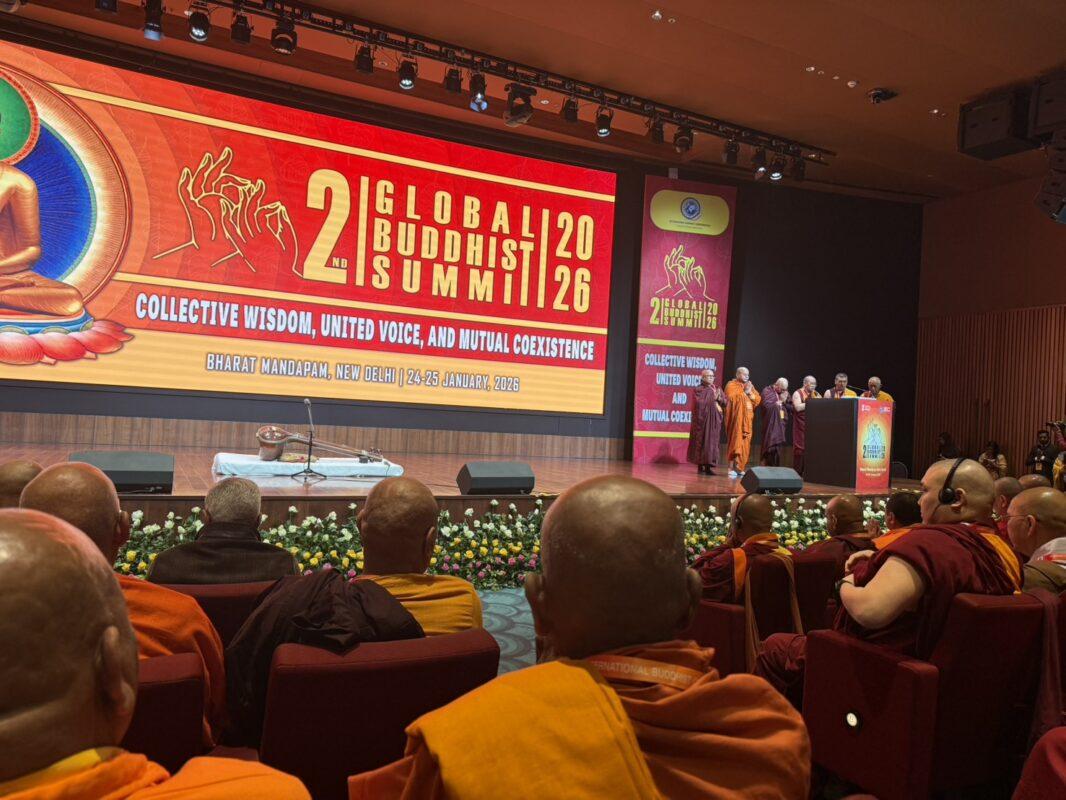
The Government of India, through the Ministry of Culture, in collaboration with the International Buddhist Confederation (IBC), hosted the 2nd Global Buddhist Summit (GBS) on January 24-25, 2026, at Bharat Mandapam, New Delhi. It is expected that Mr. Narendra Modi, Prime Minister of India, will graciously preside over the opening ceremony.
This summit was organized under the core theme "Collective Wisdom, United Voice, and Mutual Coexistence," aiming to apply Buddhist teachings and principles to resolve conflicts and various crises in today's world, encompassing social, political, and environmental issues.
The Role of Thailand and the Bodhigayavijjalaya 980 Institute on this Global Stage The Bodhigayavijjalaya 980 Institute, led by Dr. Supachai Virapuchong, Secretary-General of the Institute, along with Mr. Maris Sangiampong, Deputy Secretary-General, was honored with an invitation to participate and exchange visions with leaders of Buddhist organizations worldwide. Mr. Maris Sangiampong (Former Minister of Foreign Affairs) was also invited as a Key Panellist for the summit, alongside prominent Buddhist leaders and scholars from countries such as Bhutan, Vietnam, Japan, the United States, etc.

Global Buddhist Summit

Mr. Maris Sangiampong, Former Minister of Foreign Affairs and Deputy Secretary-General of the Bodhigayavijjalaya 980 Institute, presented his vision on the topic of "Buddhism and the Strategy of Diplomacy Connecting the World," offering strategic perspectives linking "Faith" with "International Relations" as follows:

Global Buddhist Summit

The 2nd Global Buddhist Summit – GBS
- Thailand as a "Re-exporter" of Buddhism: Viewing India as the origin and exporter of Buddhism, while Thailand plays a crucial role in receiving and "re-exporting" it to the ASEAN and Mekong Basin regions.
- Track Two Diplomacy: Utilizing the Bodhigayavijjalaya 980 Institute as a driving mechanism for relations through culture and religion to build mutual trust between nations.
- Ganga-Mekong Connectivity: Highlighting the success of the 5-Nation Dhammayatra Project (Thailand, Myanmar, Laos, Cambodia, Vietnam) and the enshrinement of the Lord Buddha's relics from India to Thailand to connect the people of the two river basins.
- Flexible yet Principled Diplomatic Philosophy: Proposing the concept of adapting to global situations ("going with the flow") but doing so with dignity and firmly adhering to national interests, using Buddhist principles as a guiding compass.

Global Buddhist Summit

Dr. Supachai Virapuchong, Secretary-General of the Bodhigayavijjalaya 980 Institute, on "Buddhist Wisdom for Management and World Peace" Dr. Supachai prepared to present the concept of applying Dhamma in the real world, emphasizing that Dhamma is universal and not limited by nationality. His key points included:

Global Buddhist Summit

The 2nd Global Buddhist Summit – GBS
- Peace Begins When Leaders Reduce "Ego": Current global crises are not caused by the people, but by the "ego" of leaders. The solution to conflicts is knowing how to practice "Forgiveness," and leaders must open their minds to learn Dhamma.
- Buddhist Entrepreneurship: Presenting a business model that focuses not only on profit but also on Corporate Social Responsibility (CSR) and Right Livelihood (Samma Ajiva), such as conducting business without harming others and managing emotions (greed/anger) in business decision-making.
- "Open-Eye Meditation": Mindfulness practice does not necessarily mean sitting with closed eyes; it is about being mindfully aware of the present moment while working or living daily life, in order to keep up with one's emotions and situations.
- The Definition of Sila (Precepts/Morality): Sila is the "normalcy" of life; it is the practice of not harming oneself and others.
Dr. Supachai also shared his vision by answering additional questions from attendees regarding Buddhist principles in business operations and leadership, expanding on "Right Livelihood" and the transition of leaders from "Power" to "Dhamma." The details are as follows:
- The Definition of a Buddhist Businessman: The key difference lies in upholding "righteousness and goodness" (Samma) as the foundation, rather than merely seeking profit.
- Rejecting Wrong Livelihood Businesses: Emphasizing the avoidance of 5 types of businesses that harm society, particularly the "arms trade," which is viewed as a major obstacle preventing world peace, as massive budgets are spent on destruction rather than creation.
- Socializing: Acknowledging the realities of business culture (such as drinking culture in China or Bhutan) but guiding on "Self-Control" and having mindful awareness to prevent losing oneself to the point of harming others.
- The Role of a Leader: A leader is a crucial gear. If a leader possesses Dhamma, they can drive policies that benefit a vast number of people.
- The "Emperor Ashoka the Great" Model – From Predator to Provider: "Dhamma is a chance." Using Emperor Ashoka the Great as a case study to prove that "no one is too bad to change." The vital lesson: Emperor Ashoka discovered that "weapons are power, but they cannot conquer the human soul." Therefore, he shifted from sending armies to sending "Dhammadhuta" (Dhamma envoys, such as Venerable Sona and Venerable Uttara) to build sustainable peace instead.
Key Highlights of the Summit In addition to discussions across 5 main topics covering social harmony, Right Livelihood, the role of the Sangha, medical science, and education, there was also the launch of "NORBU" (Neural Operator for Responsible Buddhist Understanding). This intelligent AI, dubbed a "Kalyan Mitra" (Noble Friend), is trained on Buddhist scriptural data to answer questions and converse about Dhamma in multiple languages, focusing on reaching the younger generation.
This summit marks a significant step in uniting over 800 Buddhists globally, from various sects, to sustainably build peace and well-being.

Global Buddhist Summit

The 2nd Global Buddhist Summit – GBS Gallery
S__8192188_0 S__8192184_0 S__8192185_0 S__8192207_0 vlcsnap-2026-01-28-11h14m34s186 S__8192199_0 vlcsnap-2026-01-28-11h18m45s130
The 2nd Global Buddhist Summit – GBS